
Quick summary: Discover how empowering smallholder farmers strengthens sustainable food systems enhancing traceability, resilience, and long-term supply chain sustainability.

Smallholder farmers are the backbone of global food systems yet they remain the most vulnerable to climate shocks, market volatility, and rising compliance demands. While expectations for traceability, sustainability, and data transparency are increasing, most smallholders still operate with limited access to digital tools, structured data systems, and direct market linkages. This disconnect creates a critical gap between what global supply chains require and what farmers can realistically deliver, putting both livelihoods and food system resilience at risk.
TraceX solutions help bridge this gap by enabling digital farm onboarding, real-time data capture, and end-to-end traceability, empowering smallholders to participate in compliant, transparent, and sustainable food systems.
This article is for agribusinesses, sourcing managers, NGOs, and sustainability leads who need to:
Quick Summary
Smallholder farmers those managing less than 2 hectares produce over one-third of the world’s food yet remain locked out of premium markets due to compliance barriers, limited digital tools, and fragmented supply chains. This guide covers:
If you’re responsible for sustainable sourcing or EUDR compliance, here’s the reality you’re working with: your supply chain almost certainly runs through a smallholder farm. And most of those farmers are invisible to your traceability system.
| >500M Smallholder farms worldwide FAO | 33%+ of the global food supply is produced by smallholders, FAO, 2023 | 33%+ Of global food supply produced by smallholders, FAO, 2023 |
Smallholder farmers those cultivating less than 2 hectares of land are not marginal participants in global food supply chains. They are the chain. They supply local markets, feed rural communities, and increasingly export to global buyers in coffee, cocoa, spices, and produce.
Yet despite their critical role, most smallholders remain excluded from digital traceability systems, premium markets, and EUDR-compliant supply chains not because they lack capability, but because the tools weren’t built for them.
‘You don’t build sustainable food systems from the middle of the chain. You build them from the first handshake with the farmer.’
TraceX Sustainable Sourcing Principles
Before we get into solutions, it’s important to name the specific pain points that sourcing teams, NGOs, and agribusinesses face when trying to include smallholders in verified, compliant supply chains:
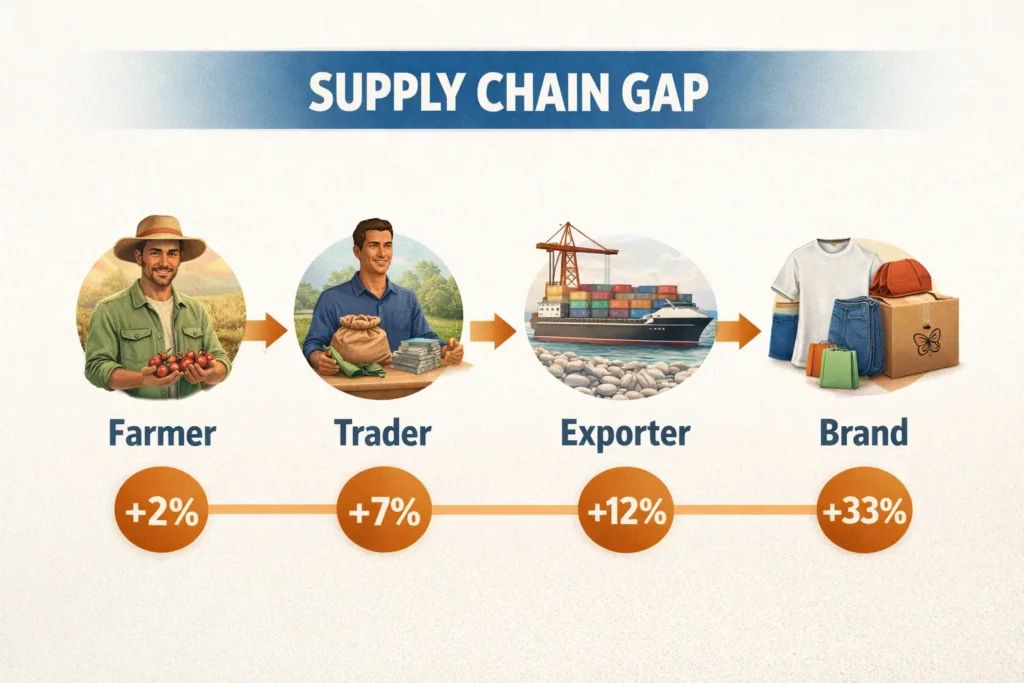
Most smallholder farmers sell through intermediaries traders, aggregators, and local markets at prices that bear no relationship to the sustainability premium their practices command. Because they lack direct connectivity to buyers and verified proof of practice, they cannot access:
The EU Deforestation Regulation (EUDR) requires operators placing cattle, cocoa, coffee, palm oil, soya, timber, and rubber on the EU market to prove their products did not originate from recently deforested land. For agribusinesses sourcing from smallholders, this creates an acute documentation challenge:
Without digital tools, this is a manual, expensive, and error-prone process and most smallholders have never interacted with compliance documentation at any level.

The economics of smallholder farming create a trap: low margins make it hard to invest in yield-improving practices, but low yields keep margins compressed. Specifically:
Nearly 80% of smallholder farmers in India, Ethiopia, and Mexico could face at least one climate hazard (drought, flooding, extreme heat) by 2050, per McKinsey’s 2023 report ‘What climate-smart agriculture means for smallholder farmers’
Is your supply chain EUDR-ready from the farm level?
Most sourcing teams discover their smallholder data gaps only during audits. Don’t wait.
Take a EUDR Readiness Assessment
The good news: these are solvable problems. Digital platforms built specifically for smallholder-inclusive supply chains are closing the compliance gap, market access gap, and data gap simultaneously and TraceX is purpose-built to do exactly that.
Here’s how the three core technology pillars map to the pain points above:
The first requirement for any traceable, EUDR-compliant supply chain is verified farm-level data. TraceX enables this through:
| Feature | What It Does | Farmer Benefit |
|---|---|---|
| GPS Plot Mapping | Captures precise farm boundaries via mobile app offline-capable for low-connectivity areas | Farmers get a verified digital land identity, enabling EUDR DDS filing |
| Digital Farmer Profiling | Records farmer name, crop type, farm size, inputs used, and certification status | Enables risk segmentation and unlocks access to premium buyer programs |
| Offline Data Collection | Field agents can capture data without internet – syncs when connected | Works in remote farming communities where connectivity is unreliable |
| Multi-language Support | Interface available in regional languages | Increases smallholder adoption and data accuracy |
Once farm data is captured, TraceX creates an unbroken audit trail from crop to export giving sourcing teams the visibility they need and giving farmers proof of their practices.
| Feature | What It Does | Farmer Benefit |
|---|---|---|
| Batch-Level Tracking | Tracks commodity movement from farm gate through processing and export | Buyers can verify origin and deforestation-free status per shipment |
| Procurement Workflow | Digitizes purchasing transactions with timestamps and quantity records | Eliminates paper records, reduces fraud, speeds payment processing |
| QR-Code Verification | Each product batch carries a scannable digital passport | Consumers and retailers can verify sustainability claims at point of sale |
| Deforestation Risk Scoring | Integrates satellite imagery and land-use data for risk assessment | Automated EUDR risk flagging before shipment not during audit |
Compliance is no longer optional for agribusinesses selling into the EU. TraceX makes EUDR compliance systematic, not manual:

Traceability platforms serve multiple stakeholders in the food system each with distinct pain points and outcomes. Here’s how TraceX maps to each:
| Stakeholder | Pain Point | TraceX Capability |
|---|---|---|
| Agribusiness / Exporter | Cannot prove deforestation-free sourcing for EU market; faces EUDR rejection risk | GPS plot mapping + DDS automation |
| Sustainability / ESG Manager | No farm-level emissions or carbon data for Scope 3 reporting | Digital MRV platform tracks carbon-reducing practices per farmer |
| Food Brand / Retailer | Supplier claims unverified; consumer trust at risk; greenwashing exposure | QR-code verified product passports; batch-level origin proof |
| NGO / Development Program | Smallholder farmers excluded from digital systems and premium markets | Offline-capable farmer profiling + market linkage tools |
| Smallholder Farmer | No proof of good practices; locked into low commodity prices via intermediaries | Digital identity + verified traceability leading to buyer-direct access |
Empowering smallholder farmers isn’t just a sustainability narrative it’s a measurable business outcome. Here’s what happens when digital traceability reaches the farm level:
‘Technoserve, as part of their Sustainable Livelihoods for Smallholder Farmers program, partnered with TraceX to ensure consistency in the quality of coffee produced, resulting in improved market linkage for the farmers.’
Sandesh Deranna, Crop Lead – Coffee Value Chain, TechnoServe
Across TraceX client engagements, the pattern is consistent:
It’s worth stating clearly: smallholder farmers are not just supply chain participants they are active custodians of ecosystem health. Their farming practices, when supported by the right tools, directly contribute to global climate and biodiversity targets:
| Feature | What It Does | Farmer Benefit |
|---|---|---|
| Agroforestry and Intercropping | Maintains diverse crop varieties and tree cover on small plots | Carbon sequestration, biodiversity preservation, reduced chemical inputs |
| Low-Input Regenerative Practices | Cover cropping, mulching, composting instead of synthetic fertilizers | Improved soil health, water retention, climate resilience |
| Localized Seed Variety Preservation | Traditional seed varieties maintained alongside commercial crops | Genetic diversity preserved critical buffer against climate shocks |
When agribusinesses invest in traceability tools that reach the farm level, they’re not just solving compliance problems. They’re creating the data infrastructure to measure, verify, and reward these practices turning smallholder climate contributions into bankable assets.
The transition to smallholder-inclusive, deforestation-free supply chains doesn’t happen automatically. It requires deliberate investment and the right platforms. Here are three concrete actions:
Empowering smallholder farmers is not just a sustainability goal it is essential for the future of global food security. As supply chains become more data-driven and compliance-focused, integrating smallholders through digital tools, traceability systems, and capacity-building initiatives will be key to creating inclusive and resilient food systems. By aligning farmer capabilities with market requirements, stakeholders can unlock long-term value improving livelihoods, ensuring transparency, and strengthening sustainability outcomes across the entire supply chain.
Support smallholders effectively – explore how EUDR impacts farmer inclusion and compliance.
Build fair and resilient supply chains – learn why fair pricing for farmers matters more than ever.
Strengthen your sourcing foundation – discover best practices for seamless farmer onboarding.
A smallholder farmer is typically defined as someone cultivating less than 2 hectares of land (FAO definition). Despite their small plot size, smallholders collectively produce over one-third of the world’s food supply and are the primary food source in much of Asia and Sub-Saharan Africa. Their diversified farming practices also contribute disproportionately to biodiversity preservation and climate resilience.
The EU Deforestation Regulation requires operators and traders to prove that specific commodities (cocoa, coffee, cattle, soya, palm oil, wood, rubber) were not produced on deforested land after December 31, 2020. For sourcing teams working with smallholders, this means GPS plot-level data must be captured and verified for every farm in the supply base – a process that requires digital tools, not manual audits.
TraceX creates a verified digital identity for each smallholder farm capturing GPS boundaries, crop data, input usage, and sustainability practices. This verified data enables farmers to prove their practices to premium buyers, certification bodies, and EUDR-regulated customers. Buyers can conduct due diligence at scale without requiring manual inspections for every farm.
Yes. TraceX’s mobile data collection application is designed for offline use. Field agents can capture farmer profiles, GPS plots, and transaction data without internet access. The data syncs automatically when connectivity is available. This makes TraceX deployable in the remote farming communities where most smallholder supply bases are located.
Most agribusinesses achieve EUDR readiness for their smallholder supply base within 8 to 12 weeks of TraceX deployment, depending on supply base size and existing data infrastructure. TraceX provides onboarding support, field agent training, and technical integration with TRACES NT and other regulatory reporting systems.