Blockchain for Food Traceability: How It Improves Safety, Transparency, and Trust
Published
, 7 minute read
Share this article
Quick summary: Blockchain for food traceability explained — how immutable records speed recalls, cut fraud and prove compliance, and the buyer questions to ask first.
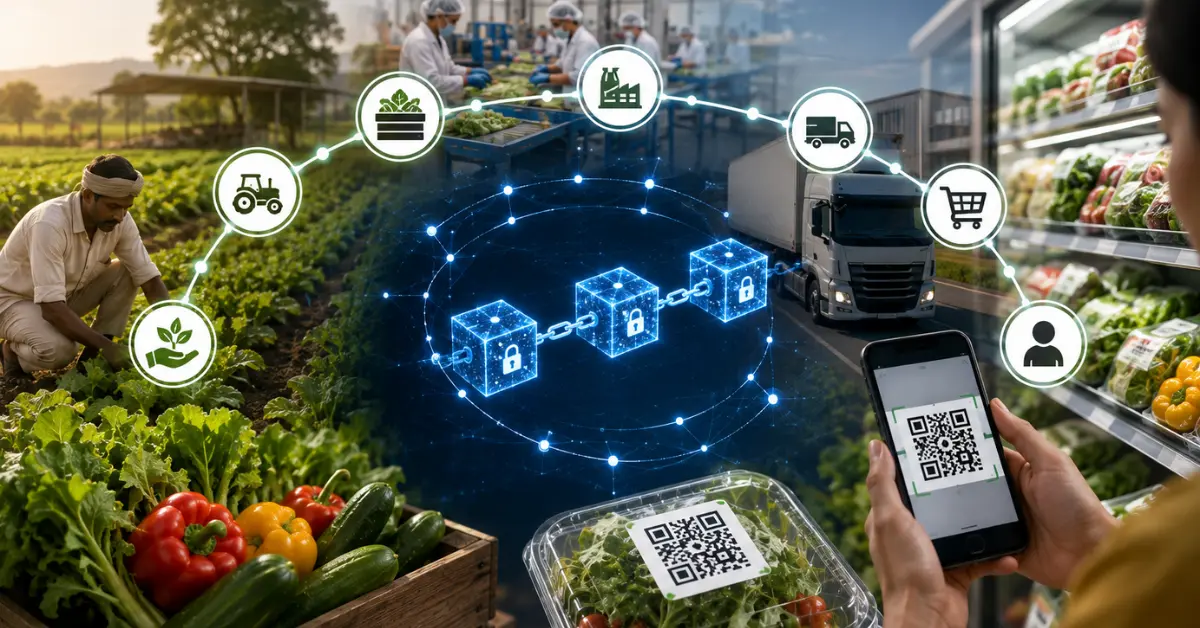
Blockchain for food traceability is a shared, tamper-proof digital ledger that records every transaction and handoff a food product passes through from farm to processor to shelf. Each entry is timestamped and cannot be altered without consensus, so every participant sees the same verified history. For food businesses facing slow recalls, fraud risk and tightening regulation, blockchain for food traceability turns a reactive scramble across spreadsheets and emails into one queryable source of truth. This guide answers the questions buyers actually ask before they invest.
Key takeaways
Blockchain for food traceability creates immutable, timestamped records across the supply chain improving recall speed, fraud prevention and compliance readiness.
It complements your ERP rather than replacing it, adding a secure verification layer on top of existing systems.
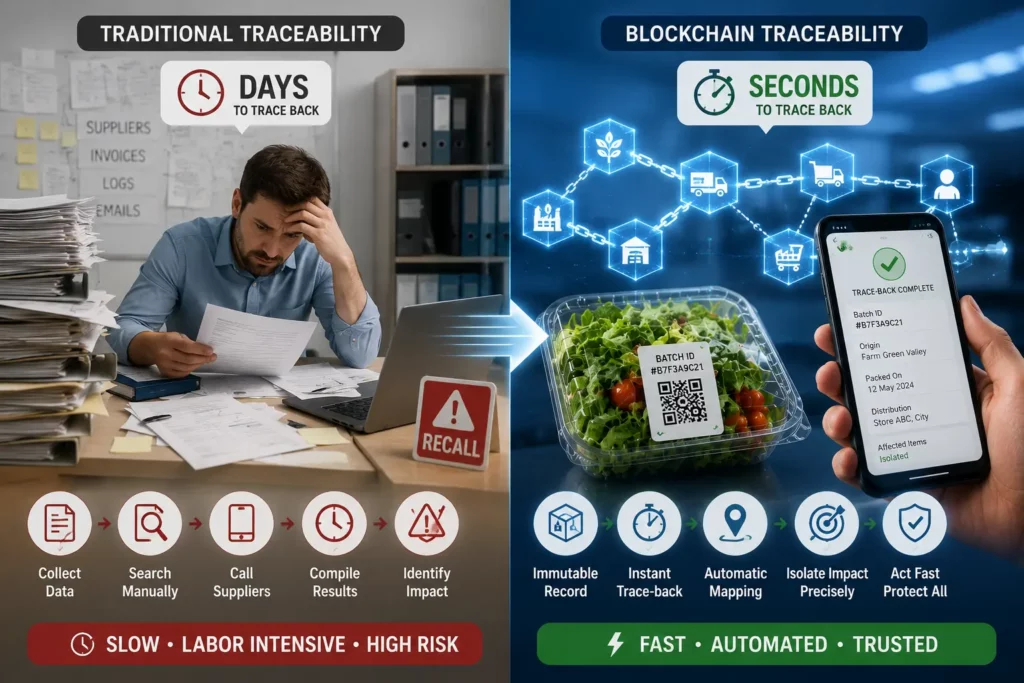
Faster trace-back shrinks contamination exposure and recall costs IBM’s Food Trust pilot cut mango trace-back from days to seconds.
Smart contracts automate compliance checks for example, blocking a shipment until GPS or lab data is uploaded.
It supports FSMA 204 (compliance date 20 July 2028), EUDR and GS1-based traceability programs.
Data quality still matters blockchain secures records but doesn’t replace supplier validation, audits and quality controls.
Ready to Strengthen End-to-End Traceability?
See how TraceX can connect your products, suppliers, batches and supply-chain activities in one digital platform.
Blockchain for food traceability is a distributed digital ledger that records every transaction, movement and quality checkpoint across the food supply chain, with each entry timestamped and immutable. Unlike a traditional database, entries can’t be edited retroactively without network consensus that is the key difference. Instead of one company controlling the data, farmers, processors, distributors, retailers and regulators all share the same trusted record. The result is a single, verifiable answer to the oldest question in food: “Where did this come from, and can I prove it?”
How does blockchain for food traceability actually work?
In practice, blockchain for food traceability records every handoff harvest, warehouse, export container as a locked, tamper-proof entry that no single party can delete or rewrite. Three properties make it powerful:
Immutability — once written, a record can’t be quietly altered, so an “organic” or “deforestation-free” claim is permanently verifiable.
Real-time visibility — as product moves stage to stage, the ledger updates instantly, so a contamination point can be pinpointed in seconds, not days.
Smart contracts — automated rules that trigger only when conditions are met: a shipment can’t move until GPS is uploaded, or payment releases only after quality tests pass.
Can You Trace Your Food Supply Chain From Farm to Fork?Discover how digital food traceability can connect suppliers, batches, processing and distribution to strengthen food safety, transparency and compliance.
When contamination occurs, every hour matters and this is where blockchain for food traceability delivers its clearest ROI. The WHO estimates roughly 600 million people fall ill each year from contaminated food, and traditional paper or siloed systems slow every investigation. With real-time batch tracking, automated audit trails and instant supplier verification, an affected lot can be isolated and pulled without recalling unaffected product reducing waste, cost and reputational damage. IBM’s Food Trust pilot famously cut mango trace-back from days to about 2.2 seconds, showing how distributed ledgers compress recall response.
Is Your Supply Chain Doing Enough to Protect Food Safety?Explore how better traceability, connected data and digital technology can help strengthen food safety, improve transparency and enable faster response to risks.
→ Read the Complete Guide to Food Safety
Does blockchain for food traceability help with compliance?
Yes blockchain for food traceability gives you structured, audit-ready digital records that simplify compliance across tightening regimes. In the U.S., the FDA’s FSMA 204 Food Traceability Rule (compliance date 20 July 2028) demands granular, event-based recordkeeping for high-risk foods. In the EU, deforestation and sustainability rules such as the EUDR require plot-level, verifiable provenance. Because a blockchain record is timestamped, shared and hard to dispute, it aligns naturally with GS1 identifiers and buyer protocols turning compliance from a document hunt into a query.
See How TechnoServe Transformed Coffee Traceability With TraceXDiscover how TechnoServe and TraceX brought end-to-end digital traceability to coffee produced by 3,500 farmers in Araku Valley, improving transparency, data management and sustainable sourcing.
What are the challenges of blockchain in food supply chains?
Adoption isn’t automatic, and a credible evaluation of blockchain for food traceability weighs the friction as well as the upside. Common challenges include:
Integration and cost — upfront integration expense and legacy-system compatibility.
Data standardisation — inconsistent formats across partners; GS1 standards help but need coordination.
Supplier onboarding — resistance and limited rural connectivity at the first mile.
Garbage in, garbage out — a ledger is only as reliable as the data entered, so validation and audits still matter.
How does the TraceX platform deliver blockchain for food traceability?
The TraceX Food Traceability platform operationalises blockchain for food traceability from the first mile to the buyer’s shelf. Field teams onboard farmers and capture GPS at plot level using a mobile app that works offline, then log crop, harvest and post-harvest events grading, drying, packaging, storage, transport each timestamped and geo-tagged against a unique batch. Every batch carries a QR code that buyers, auditors or consumers can scan to see origin, sustainability claims, handling history and certificates proof backed by data, not declarations.
“Blockchain for food traceability isn’t about the technology it’s about turning ‘I think it came from…’ into a record you can prove in seconds. In a market defined by proof, not promises, that’s the difference between a recall you contain and one that defines your brand.”
Ready to Make Your Supply Chain More Traceable?
See how TraceX can help you connect supply-chain data, improve visibility and strengthen compliance with a live, tailored demo.
Produce audit-ready records and trace any batch back in seconds
Generate scannable QR provenance for buyers, auditors and consumers
Scale across commodities and multi-tier chains without adding headcount
Frequently Asked Questions
Is blockchain too complex for food supply chains?
Not when implemented well. Modern blockchain for food traceability platforms hide the technical layer behind simple dashboards and mobile apps for suppliers, processors and retailers, so day-to-day users never touch the underlying ledger.
Does blockchain replace my existing ERP or supply chain systems?
No. It adds a secure verification layer and integrates with ERP, procurement and quality-management tools rather than replacing them. Think of it as trust infrastructure on top of what you already run.
Is blockchain expensive to implement?
Cost scales with the size and complexity of your supply chain, but the investment is usually offset by lower recall costs, reduced fraud and faster compliance. For most food businesses the long-term savings outweigh setup expense.
Can small suppliers and smallholder farmers participate?
Yes. With mobile-based onboarding, offline capture and structured digital forms, even smallholders and small processors can contribute data without complex infrastructure.
Does blockchain guarantee food safety?
No technology guarantees safety on its own. Blockchain for food traceability strengthens data integrity and recall speed, but it must be paired with supplier validation, audits and quality controls it improves oversight, it doesn’t replace due diligence.
How does blockchain help with FSMA 204 and EUDR?
It captures the granular, event-based records both regimes expect traceability lot codes and Key Data Elements for FSMA 204, and plot-level, verifiable provenance for the EUDR in a timestamped, audit-ready form you can retrieve on request.
What foods benefit most from blockchain traceability?
Blockchain for food traceability delivers the fastest payback in high-risk and high-value categories: coffee, cocoa, spices, produce, dairy, seafood and meat anywhere recalls, fraud or sustainability claims carry real financial and reputational risk.
Start using TraceX
Transparency, Trust, & Success for your Climate Journey.
We use cookies on our website to give you the most relevant experience by remembering your preferences and repeat visits. By clicking “Accept All”, you consent to the use of ALL the cookies. However, you may visit "Cookie Settings" to provide a controlled consent.
This website uses cookies to improve your experience while you navigate through the website. Out of these, the cookies that are categorized as necessary are stored on your browser as they are essential for the working of basic functionalities of the website. We also use third-party cookies that help us analyze and understand how you use this website. These cookies will be stored in your browser only with your consent. You also have the option to opt-out of these cookies. But opting out of some of these cookies may affect your browsing experience.
Necessary cookies are absolutely essential for the website to function properly. These cookies ensure basic functionalities and security features of the website, anonymously.
Cookie
Duration
Description
cookielawinfo-checkbox-analytics
11 months
This cookie is set by GDPR Cookie Consent plugin. The cookie is used to store the user consent for the cookies in the category "Analytics".
cookielawinfo-checkbox-functional
11 months
The cookie is set by GDPR cookie consent to record the user consent for the cookies in the category "Functional".
cookielawinfo-checkbox-necessary
11 months
This cookie is set by GDPR Cookie Consent plugin. The cookies is used to store the user consent for the cookies in the category "Necessary".
cookielawinfo-checkbox-others
11 months
This cookie is set by GDPR Cookie Consent plugin. The cookie is used to store the user consent for the cookies in the category "Other.
cookielawinfo-checkbox-performance
11 months
This cookie is set by GDPR Cookie Consent plugin. The cookie is used to store the user consent for the cookies in the category "Performance".
viewed_cookie_policy
11 months
The cookie is set by the GDPR Cookie Consent plugin and is used to store whether or not user has consented to the use of cookies. It does not store any personal data.
Functional cookies help to perform certain functionalities like sharing the content of the website on social media platforms, collect feedbacks, and other third-party features.
Performance cookies are used to understand and analyze the key performance indexes of the website which helps in delivering a better user experience for the visitors.
Analytical cookies are used to understand how visitors interact with the website. These cookies help provide information on metrics the number of visitors, bounce rate, traffic source, etc.
Advertisement cookies are used to provide visitors with relevant ads and marketing campaigns. These cookies track visitors across websites and collect information to provide customized ads.
Download the 2026 Traceability Scorecard and Benchmark Your Supply Chain Across 10 Critical Capabilities.
Download our eBook
Don’t Wait for an Audit to Find Your EUDR Gaps
The 2026 Simplification Package changes how HS codes, DDS pass-through and geolocation rules apply to you. Get the free guide and 20-point readiness checklist before enforcement catches you unprepared.